Revisiting Stop the Slip: Slip-and-Fall Facts Re-Examined Eight Years Later (2025 Update)

When I wrote Stop the Slip eight years ago, it became one of the first books to translate injury-surveillance data into practical, easy-to-understand insights for homeowners, seniors, safety managers, and employers. At the time, the statistics were startling—but in 2025, the picture is even sharper, and in many ways, more urgent.
Falls remain a silent public-health crisis. They continue to cause more emergency-room visits than any other injury category, and they now rival or exceed the annual toll from motor-vehicle crashes, fires, and even the flu.
As I continue researching fall data, it’s clear that the trends identified in Stop the Slip have not only held, but many have intensified.
Below is an updated, 2025-ready look at some of the core factoids from the original book, refreshed with modern data that show why fall-prevention still deserves national attention.
Factoid #1: Falls are the #1 Cause of Injury-Related Emergency Room Visits
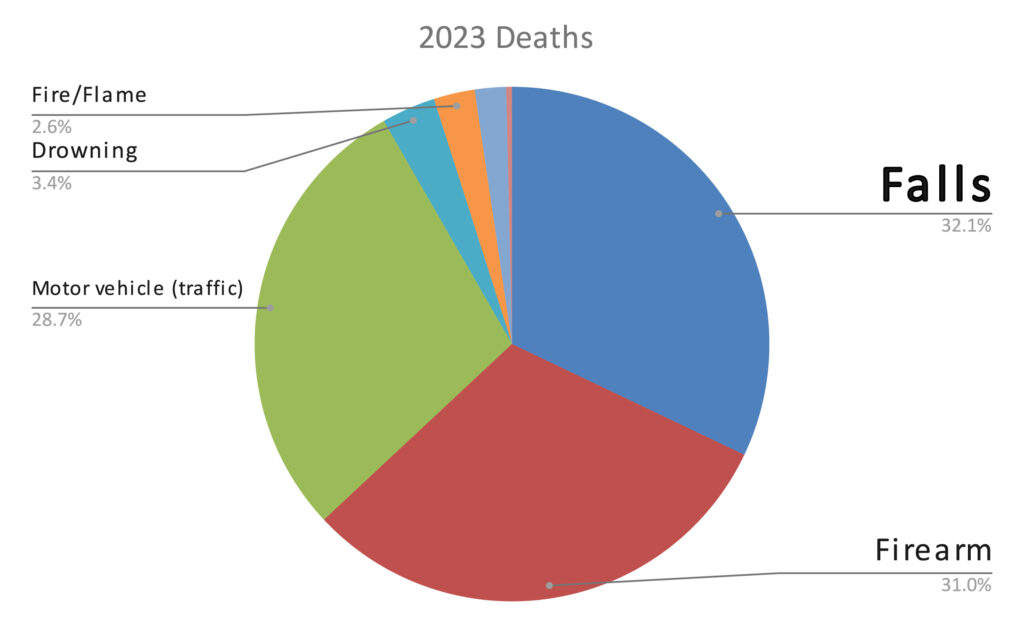
8 years later, falls still remain the number one cause of non-fatal emergency department visits for injury in the United States, accounting for approximately 35% of all such visits in 2023.
- Falls continue to be the leading cause of injury-related ER visits in the U.S.
- Falls consistently represent about one-third of all nonfatal ED injury cases.
(Source: CDC WISQUARS Fatal and Nonfatal Injury Reports, 2023 data).
Even with evolving worker protection systems and updated reporting standards, one pattern has remained remarkably consistent: falls send more Americans to the emergency room than any other cause of injury. The persistently high volume of fall-related ER visits—far surpassing motor-vehicle crashes and other major injury categories—shows that slips, trips, and falls are not rare accidents, but an everyday, systemic safety problem.
This ongoing trend underscores a critical truth: if we want to meaningfully reduce healthcare burden and prevent avoidable injuries, fall-prevention efforts must take center stage.
Factoid #2: Falls Are the Leading Cause of Traumatic Brain Injury (TBI)
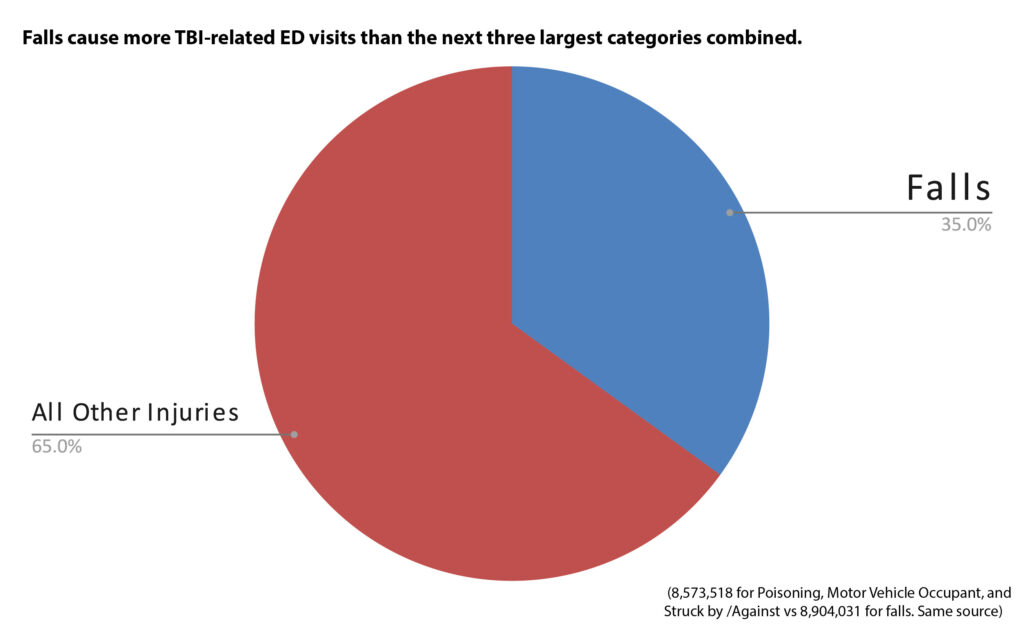
In 2025, falls are still the leading cause of traumatic brain injury (TBI).
- Falls continue to be the number one cause of TBI-related hospitalizations in the United States.
- Falls now account for nearly half of all TBI hospitalizations, making them the most common way people sustain a serious brain injury.
- While firearm-related injuries are the leading cause of TBI-related deaths, falls remain the dominant cause of non-fatal TBIs across all age groups.
- Among older adults, falls cause more TBI hospitalizations and deaths than any other mechanism.
(Source: CDC Traumatic Brain Injury Data & Statistics, updated 2025).
These updated figures make one thing clear: the consequences of a fall extend far beyond a scraped knee or a temporary bruise. Falls are still the most common pathway to traumatic brain injury in the United States, responsible for nearly half of all TBI-related hospitalizations and the majority of serious non-fatal brain injuries across every age group.
For older adults, especially, a single fall can trigger a cascade of health complications from long-term cognitive decline to permanent disability or even death. The data reinforces a sobering but essential truth: when a fall occurs, the stakes can be life-changing. Preventing falls isn’t just about avoiding minor injuries; it’s about reducing the risk of one of the most devastating medical emergencies a person can experience.
Factoid #3: Falls Cause More Injuries and Deaths than Gun Violence
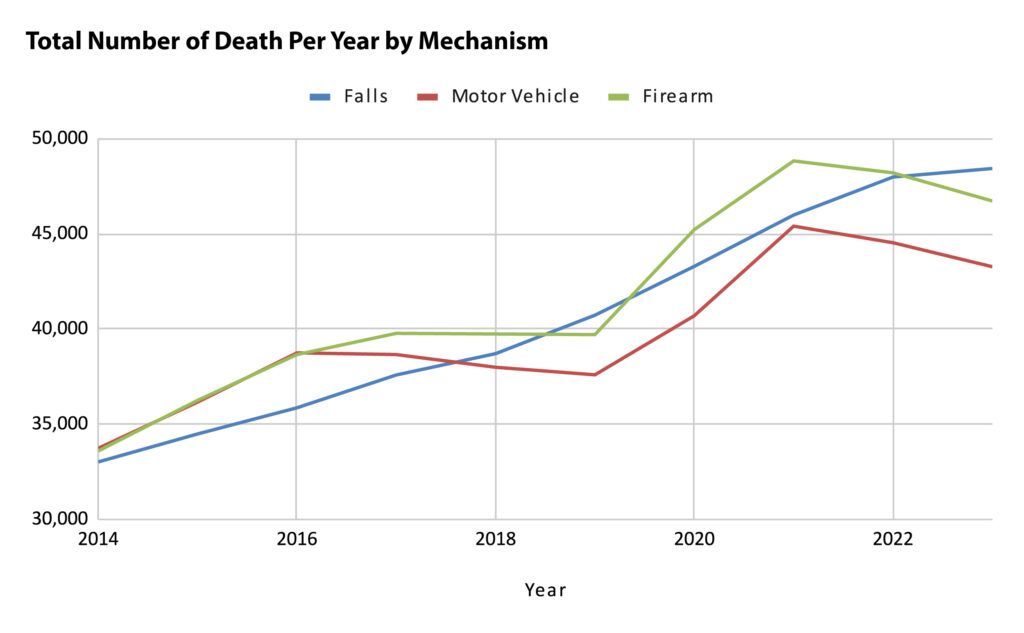
Falls still cause more injuries and deaths than gun violence.
- In 2023, 48,433 people of all ages in the United States died from unintentional falls — a number that has risen sharply over the past two decades.
- By comparison, firearm-related deaths (all intents combined) totaled 46,728 in 2023.
- That means falls kill more Americans each year than gun violence.
- Non-fatal fall injuries widen the gap even further, sending millions to the emergency room annually — far more than all firearm-related injuries combined.
(Source: CDC WISQUARS Fatal and Nonfatal Injury Reports, 2023 data).
When you compare the numbers side by side, the message is impossible to ignore: falls quietly take more lives each year than gun violence—a statistic that rarely makes headlines. Fall injuries affect every age group, in every community, in the most ordinary places: homes, porches, sidewalks, stores, workplaces, and driveways.
With millions of non-fatal fall injuries occurring annually, the data makes a compelling case for elevating fall prevention to the same level of national attention given to other major public-safety issues. Preventing falls isn’t just about reducing accidents; it’s about reducing one of the country’s most widespread and underestimated causes of serious injury and death.
Factoid #4: Falls are Causing More Deaths than Ever Before
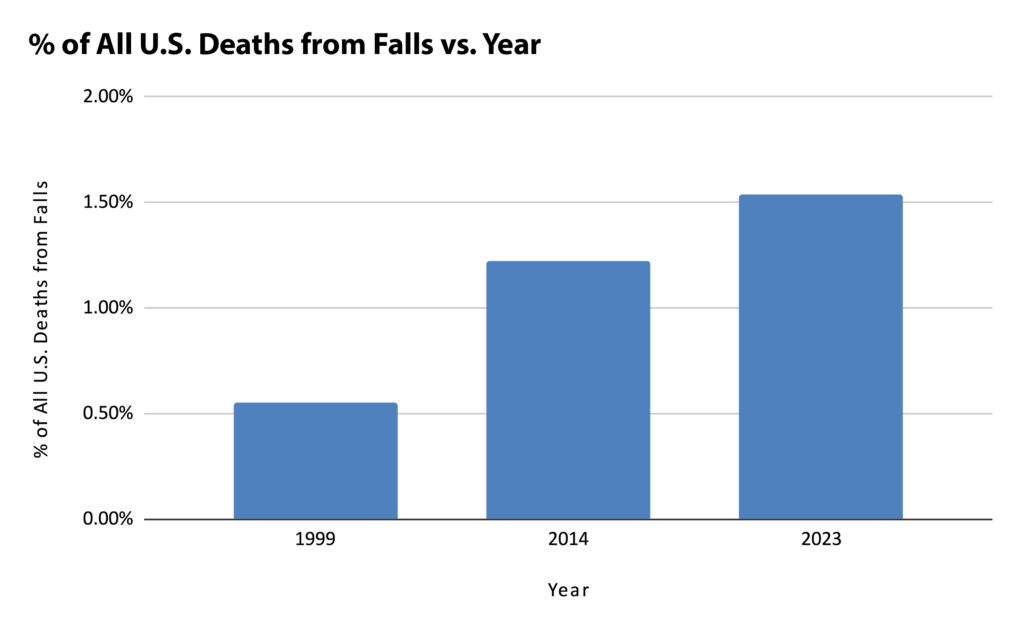
Falls have grown from causing 0.55% of all U.S. deaths in 1999 to approximately 1.54% of all deaths in 2023.
This represents an increase of over 180% in the share of total national mortality.
Falls are now the 12th leading cause of death in the United States
(up from 14th in 2014).
- In 1999, falls accounted for 0.55% of all U.S. deaths.
- By 2014, that number had risen to 1.22%.
- In 2023, falls increased again to 1.54% of all deaths.
(48,433 fatal falls out of ~3.15 million total U.S. deaths in 2023.)
(Source: CDC WISQUARS Fatal and Nonfatal Injury Reports, 2023 data).
The long-term trend is unmistakable: fatal falls are rising at a pace that far exceeds population growth, medical advances, and safety improvements. In just over two decades, the share of total U.S. deaths attributed to falls has nearly tripled—elevating falls from a mid-tier public-health concern to the 12th leading cause of death nationwide.
This steady climb shows that fall risk isn’t merely a matter of aging demographics; it reflects deeper issues in home safety, mobility, chronic conditions, and the environments where people live and move every day. As fall-related mortality continues to increase year after year, the data reinforces an urgent reality: fall prevention must evolve from an afterthought to a core part of national health and safety efforts. Preventing just a fraction of these incidents would save tens of thousands of lives every year.
Factoid #5: The Work Environment is Much Safer from Fall Injuries and Deaths
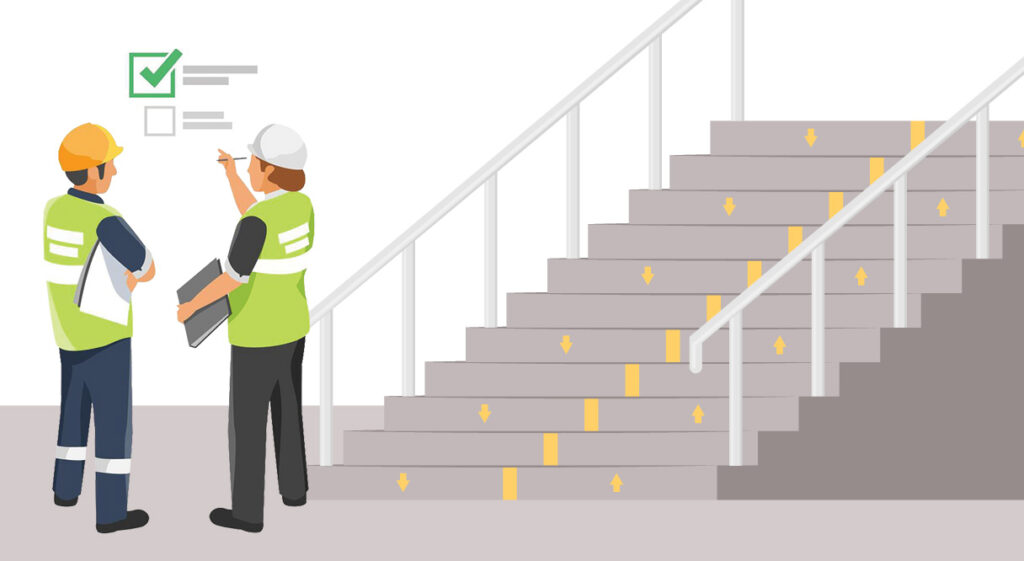
While some might assume that working conditions can cause more slips and falls, falls are still much more likely to occur at home than at work.
- Falls continue to occur far more often outside the workplace than on the job.
- For working-age adults (18–65), only a small share of fall-related injuries and deaths occur at work compared with the home and community.
- Workplaces benefit from OSHA regulations, safety training, consistent hazard controls, routine inspections, and employer-level accountability—protections that most homes and public areas simply don’t have.
- At home, in parking lots, stores, sidewalks, porches, decks, and everyday environments, the lack of structured safety policies keeps fall risk significantly higher than at work.
- To stay safe, individuals should adopt the same slip, trip, and fall prevention measures businesses use—proper footwear, hazard removal, lighting, maintenance, handrails, and situational awareness.
(Source: Bureau of Labor Statistics (BLS); NEISS All Injury Program operated by the Consumer Product Safety Commission (CPSC); National Center for Injury Prevention and Control, CDC via WISQARS™.)
The past and current data make a powerful point: the place we feel safest—home—is actually where most serious falls occur. While workplaces benefit from OSHA oversight, structured training, enforced safety standards, and regular inspections, these protections rarely exist in the environments where people spend the majority of their time.
Sidewalks, garages, driveways, porches, stores, parking lots, and living spaces present everyday hazards that go unaddressed simply because there’s no system—or accountability—to manage them. That’s why working adults are significantly less likely to experience a fall at work than in their own communities.
The takeaway is straightforward: if individuals applied even a fraction of the safety discipline used in workplaces to their homes and daily routines, thousands of injuries could be prevented every year. Proper footwear, clear walkways, adequate lighting, secure handrails, and routine maintenance aren’t just workplace safety essentials—they’re life-saving habits for everyone, everywhere.
Most falls happen at home—take 5 minutes to reduce your risk.
Get the Stop the Slip Home Audit Checklist and start protecting your family today.
Fall Prevention: What Stop the Slip Still Gets Right in 2025
While the updated data shows how serious slip-and-fall injuries have become, the good news is that most falls are preventable. In Stop the Slip, I outline a practical, systematic approach to reducing fall risk—one that remains just as relevant, and arguably even more necessary, in 2025.
The book’s prevention framework revolves around the ALERT System™, a five-step method designed to help individuals identify hazards, correct them quickly, and build long-term habits that reduce fall risk. The ALERT method is a simple way for anyone, homeowners, seniors, parents, and employers, to make meaningful safety improvements.
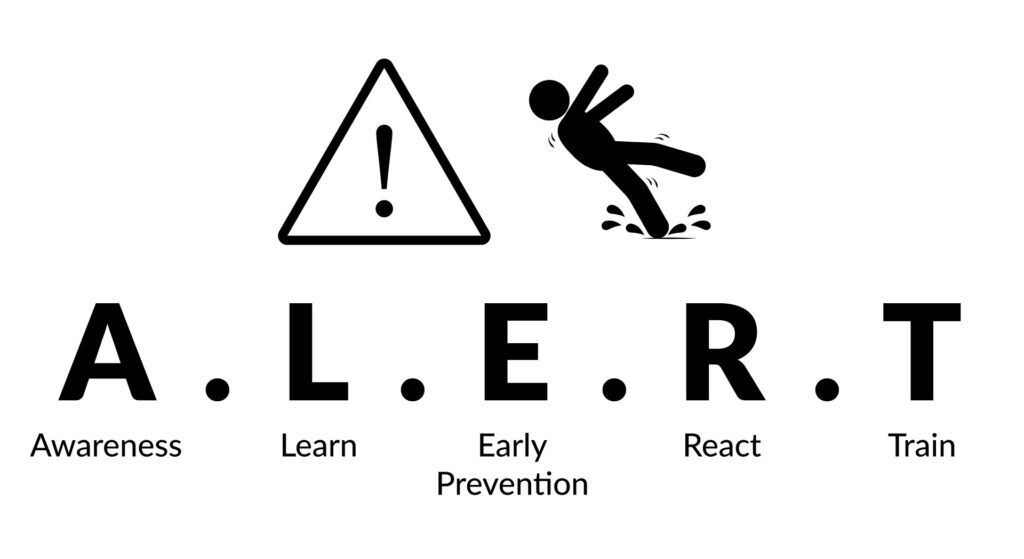
The ALERT System™: Five Steps to Reduce Fall Risk
A — Awareness
Awareness is the foundation of fall prevention. The book emphasizes recognizing high-risk situations, building a mental “STF warning system,” and paying attention even in familiar environments like bathrooms, kitchens, and stairs. Most falls happen in the places we feel safest because our guard is down.
L — Learn
Learn what causes falls in your environment—slippery floors, cluttered pathways, poor lighting, steep or uneven stairs—and learn from both your own experiences and others’. The book encourages documenting hazards and becoming familiar with effective products and solutions.
E — Early Prevention
Early awareness and early action dramatically reduce fall risk. The book stresses that fall prevention shouldn’t start only in older adulthood. Teaching children and young adults how to identify hazards helps build lifelong safety habits.
R — React
When you see a hazard—fix it. Don’t step over it, ignore it, or assume you’ll remember later. Whether it’s water on the floor, a loose rug, poor lighting, or clutter on stairs, immediate action is the most effective protection.
T — Train
Train your body (balance, strength, mobility) and your mind (situational awareness). Training isn’t just physical; it’s also about sharing knowledge. Stop the Slip encourages teaching family members, coworkers, and friends so everyone becomes safer together.
Most falls can be prevented with one simple walkthrough.
Whether you’re safeguarding your family or your workforce,
a fall-prevention audit is the best place to start.
Top 10 Actionable Fall-Prevention Tips (Based on Stop the Slip)

✔ 1. Create a mental “fall-risk radar.”
Per the ALERT System, awareness is the first line of defense. Treat fall hazards the same way you’d treat a hornet’s nest—something that deserves caution and quick action.
✔ 2. Fix hazards the moment you notice them.
Don’t step over a spill, loose rug, or object on the stairs, hoping to remember later. React immediately.
✔ 3. Improve lighting—especially in high-traffic and nighttime areas.
Use nightlights in hallways, bedrooms, and bathrooms so low-light navigation doesn’t lead to a misstep.
✔ 4. Add non-slip solutions to known problem areas.
Bathrooms, kitchens, stairs, entryways, decks, garages, and porches all benefit from indoor non-slip adhesive treads, anti-slip outdoor treads, or textured coatings.
✔ 5. Keep walking paths clear and uncluttered.
Clothing, shoes, kids’ toys, cords, loose decor, and pet beds are all fall triggers—especially at night.
✔ 6. Strengthen balance and mobility.
Consistent balance-focused activity—yoga, tai chi, strength training—reduces fall risk across all ages (supported in the ALERT “Train” step).
✔ 7. Audit your home regularly.
Use a room-by-room walkthrough, as outlined in the Home Audit Checklist, to catch hazards before they cause harm.
✔ 8. Install secure handrails and grab bars.
Stairways, bathrooms, decks, and garages all benefit from stable support points.
✔ 9. Wear appropriate footwear inside and outside.
Smooth-soled socks, worn-out shoes, flip-flops, and slippery slippers are leading contributors to indoor falls.
✔ 10. Teach fall awareness to family members.
Share the ALERT approach with kids, teens, and older adults. Safety knowledge is most effective when everyone participates.
Final Thoughts: Why Fall Prevention Matters More Than Ever in 2025 and Beyond
Eight years after Stop the Slip first translated injury data into practical safety insights, the need for fall prevention has only grown more urgent. The updated 2025 data shows a clear and troubling pattern: falls remain the leading cause of injury-related ER visits, the top driver of traumatic brain injuries, and a rapidly rising cause of accidental death in the United States. They outpace motor-vehicle crashes, fire injuries, and even gun violence in both frequency and impact—yet they receive only a fraction of the national attention.
But the story doesn’t end with the numbers. The most important lesson from revisiting these factoids is that falls are preventable. Awareness, early action, better home environments, improved traction, and simple daily habits can dramatically reduce the likelihood of a life-altering injury. The ALERT System™ and Home Audit Checklist from Stop the Slip remain powerful, accessible tools that anyone can use—regardless of age or mobility level.
Whether you’re a homeowner, caregiver, safety professional, or simply someone who wants to protect the people around you, fall prevention isn’t about fear—it’s about empowerment. Every small improvement to your surroundings or routines is a step toward safeguarding your independence, your health, and your quality of life.
Falls may be common, but they don’t have to be inevitable. With the right knowledge and a few intentional changes, we can make our homes, communities, and workplaces safer for everyone—today and for years to come.